The System of Political Repression in Belarus Must Be Dismantled
Executive summary
Political repression in Belarus is a core pillar of the Lukashenka regime and is now embedded in state institutions and the legal code. Recent conditional releases of political prisoners have provided humanitarian relief but have fallen far short of the systemic change required to dismantle this repressive framework. Establishing a pattern of exchanging political prisoners for sanctions relief motivates the regime to perpetuate domestic and transnational repression, turns Belarusians into bargaining chips in negotiations, and encourages Lukashenka’s regime to continue replenishing the supply of hostages.
Belarus Freedom Forum calls on the U.S. Congress to address this policy gap in an updated Belarus Democracy Act by making sanctions relief for Belarus dependent on verifiable legal and institutional changes. These conditions should include:
- Repeal of repressive laws and regulations.
- Introduction of safeguards against renewed politically motivated prosecutions.
- Full amnesty, legal rehabilitation, and restoration of rights (not merely conditional release) for all political prisoners held by the Lukashenka regime.
Why Political Repression in Belarus Matters to the U.S. and the International Community
Political repression created a human rights crisis in Belarus that extends beyond its borders. The Lukashenka regime’s use of transnational repression threatens the rights of United States residents and naturalized citizens and their families. Belarus wages a hybrid war against NATO on Russia’s behalf and continues to manufacture one security crisis after another: hijacking airliners, trafficking migrants to Poland’s and Lithuania’s borders, disrupting air travel in Lithuania, providing facilities and infrastructure for Russia’s invasion of Ukraine, and hosting Russia’s nuclear weapons.
If unaddressed, the Lukashenka regime’s practices threaten to normalize hostage diplomacy, transnational repression, and the use of domestic political prisoners as leverage in international negotiations. These trends will lead to the adoption of repressive practices and further erosion of democratic principles worldwide, which in turn would drive a global increase in violence, disruption of trade, and mass migration.
What the U.S. Congress Can Do
The Lukashenka regime’s willingness to trade political prisoners for sanctions relief demonstrates the effectiveness of sanctions as leverage. Congress now has an opportunity to ensure that the pressure built through years of sanctions enforcement by the United States and its allies is used to secure lasting improvements in Belarus’s human rights situation. The bipartisan Belarus Democracy Act, first passed in 2004 and amended in 2006, 2011, 2020, and introduced again in 2025, provides a legislative foundation for further congressional action, including renewed conditions for sanctions relief and accountability for political repression.
Recommendations for the U.S. Congress
- Treat political repression in Belarus as a system, not a series of individual events.
- Recognize that Belarus’ system of political repression is sustained by a combination of repressive laws.
- Require the repeal of repressive laws in Belarus to dismantle the system of repression (see the analyses of several specific laws below in the Legal Code Used as an Instrument of the Repressive System section).
- Demand the immediate end to persecution in retaliation for the legitimate exercise of civil and political rights.
- Recognize that prisoner releases without legal reform are reversible and do not constitute genuine progress.
- Facilitate the unconditional release of all political prisoners.
- Require the repeal of repressive laws as a condition of lifting the sanctions.
- Sanction the individuals involved in drafting and implementing the repressive laws — lawmakers and judges alike.
- Fund sanctions enforcement and implement sanction snapback mechanisms to ensure lasting progress toward ending repression.
What Can Individual Representatives and Senators Do Today
Belarus Freedom Forum encourages all Representatives and Senators representing Belarusian American constituents and our allies of Eastern European descent to join the bipartisan Friends of Belarus Caucus in the U.S. House of Representatives and Free Belarus Caucus in the U.S. Senate.
Background: How Repression Became Institutionalized in Belarus
Since winning the presidential elections in 1994, Lukashenka has consolidated and maintained his power through political repression as a means of coercion and control. Since then, the regime has targeted Belarusians for exercising fundamental rights guaranteed by the Constitution of the Republic of Belarus. Repression intensified after the 2001, 2006, 2010, and 2020 presidential elections, all of which the international community recognized as neither free nor fair.
In response to the peaceful protests against the fraudulent 2020 presidential election, the Lukashenka regime initiated unprecedented repression affecting hundreds of thousands of people. The authorities used illegal surveillance, arbitrary arrests, imprisonment, ill treatment, torture, and forced exile. In response to serious human rights violations in Belarus, the United States, the European Union, Switzerland, the UK, Canada, Japan, Australia, and New Zealand imposed sanctions on the Lukashenka regime.
The Lukashenka regime institutionalized repression by codifying it into laws and government structures. Administrative, legislative, judicial, security, financial, and educational systems, along with state enterprises, have been integrated into a repressive machine. The regime has even forced private businesses to participate in oppressive activities.
After 2020, the formalization of repressive extrajudicial practices has led to an increase in repressive laws, which are intentionally vague and lack clarity, allowing for flexible interpretation and arbitrary enforcement. The broad definition of “extremism” and related offenses in Belarus gives authorities significant discretion to prosecute individuals for nonviolent political activities or public criticism.
2025–2026 Prisoner Releases and Sanctions Relief: Humanitarian Gains, No Systemic Change
In 2025 and 2026, in exchange for the suspension of U.S. economic sanctions, Lukashenka released nearly 500 political prisoners. These releases are long-awaited humanitarian developments.
Nevertheless, the regime still holds over 800 political prisoners and continues to take new people hostage. The release of political prisoners in exchange for sanctions relief is conditional — the regime either forcibly and in violation of the Belarusian constitution deported the released prisoners out of the country, making them effectively stateless, or placed them under surveillance and control, with threats of re-arrest.
While the conditional releases of political prisoners offer some humanitarian relief, they do not constitute systemic change. The repressive system continues to function, and the releases occur within that framework. The exchange of prisoners for sanctions is a temporary tactic that uses Belarusian citizens as bargaining chips in negotiations, which encourages the regime to create new political prisoners and reinforces the system of arbitrary detentions.
Legal Code Used as an Instrument of the Repressive System
A meaningful change in Belarus is impossible without dismantling the system of political repression. A framework for dismantling the repression system established by the Lukashenka regime in Belarus has to start from identifying its underpinning laws.
Domestic Oppression
Article 342 and Article 342-2 — Organizing or Participating in Actions Grossly Disrupting Public Order; Repeated Violation of Assembly Procedures
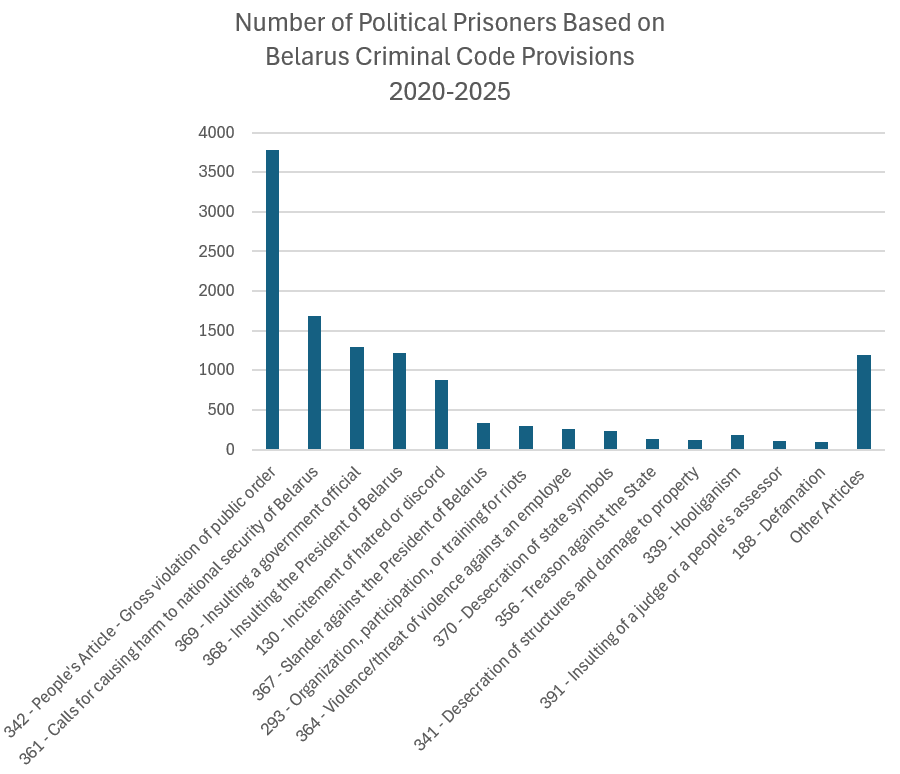
Article 342 is the foundational statute of the post-2020 mass repressions. It criminalizes the “organization, preparation, or active participation in group actions that grossly violate public order.” Its central feature is intentional vagueness: the phrase “grossly violating public order” has no objective statutory definition and has been interpreted by Belarusian courts to encompass any unauthorized street gathering, any coordinated presence at a location designated by protesters, and even the act of standing near a crowd without actively dispersing. Starting in August 2020, Article 342 became the single most frequently applied criminal charge against participants in the post-election protests, with tens of thousands of individuals across the country charged under it.
Article 342-2, added to the Criminal Code after 2020, addresses “repeated violation of the procedure for organizing or conducting mass events.” Where Article 342 requires evidence of “active participation,” Article 342-2 criminalizes mere attendance at any assembly that has not been pre-approved by authorities — a near-impossible standard under Belarus’s restrictive Law on Mass Events, which effectively prohibits all unsanctioned public gatherings. Together, Articles 342 and 342-2 function as a two-tiered system: Article 342-2 applies to first-time attendees at protests, while Article 342 is reserved for those whom authorities characterize as organizers, coordinators, or repeat participants. The combination ensures that virtually any form of visible civic engagement with an unauthorized gathering is a criminal offense.
These provisions are irreconcilable with the right to peaceful assembly guaranteed under Article 21 of the International Covenant on Civil and Political Rights, to which Belarus is a party.
Articles 368 and Articles 369 — Insulting the President and Insulting a Government Official
Other frequently used repressive provisions include Articles 368 and 369 of the Criminal Code of the Republic of Belarus, which establish criminal liability for “insulting the President” and “insulting a government official.” Their application is incompatible with both constitutional guarantees and Belarus’s international human rights obligations. Article 33 of the Constitution guarantees freedom of expression; however, in practice, these provisions are systematically used to suppress criticism directed at the head of state and government officials, thereby undermining the constitutional right to free speech and eroding fundamental democratic principles. Belarus is also a party to the International Covenant on Civil and Political Rights (ICCPR), and the UN Human Rights Committee has explicitly stated in General Comment No. 34 that laws criminalizing criticism of the government or public officials are incompatible with Article 19 of the Covenant.
At the same time, Articles 368 and 369 introduce a form of selective protection that is fundamentally inconsistent with the principle of equality before the law. By affording heightened protection exclusively to the President and government officials, these provisions create a legal asymmetry whereby certain categories of individuals are shielded from criticism through criminal sanctions, while no comparable protection exists for others. This approach is incompatible with Article 22 of the Constitution of the Republic of Belarus, which guarantees equality before the law. As Article 19 has stated in its Defining Defamation: Principles on Freedom of Expression and Protection of Reputation — endorsed by the UN Special Rapporteur on Freedom of Opinion and Expression, the OSCE Representative on Freedom of the Media, and the OAS Special Rapporteur on Freedom of Expression — “public officials, including monarchs, heads of state, and government officials, also should not be entitled to special protections under defamation laws”; on the contrary, “those in these positions in fact have to tolerate greater scrutiny.”
A further fundamental defect lies in the vagueness of the term “insult” and the resulting violation of the principle of legal certainty. The notion of “insult” as used in Articles 368 and 369 lacks a precise legal definition and is inherently susceptible to broad and arbitrary interpretation by prosecutorial and judicial authorities. This undermines the principle of nullum crimen sine lege, which requires that criminal offenses be formulated with sufficient clarity to enable individuals to foresee the legal consequences of their conduct.
The penalties provided under Articles 368 and 369 — including imprisonment — are grossly disproportionate to any legitimate aim that may be served by protecting the reputation of a public official.
In practice, Articles 368 and 369 are applied predominantly against opposition activists, independent journalists, and other critics of the incumbent government. According to data compiled by the Human Rights Center Viasna, since 2020, at least 1,239 individuals have been convicted under Article 368 and 1,219 under Article 369. The majority of those convicted have since been placed on official “extremist” lists, facing formal and informal additional restrictions on employment as well as limitations and increased oversight of their financial activities. This pattern of selective enforcement demonstrates that these provisions do not operate as neutral legal norms aimed at protecting personal dignity, but rather as instruments of political repression. Their application is therefore fundamentally incompatible with the principles of a democratic state governed by the rule of law, as well as with Belarus’s obligations under international human rights obligations.
Article 411 — Willful Disobedience to the Requirements of the Administration of the Correctional Institution
Article 411 of the Criminal Code has emerged as the regime’s primary mechanism for the indefinite detention of political prisoners who have already served their original sentences. Under this provision, any disciplinary infraction within a penal colony — including refusal to perform forced labor, failing to stand at inspection, or a verbal exchange with a guard — can be characterized as “malicious disobedience” and used as the basis for a new criminal sentence of up to one additional year of imprisonment.
This mechanism is used repeatedly against the same individuals. As of 2025, multiple political prisoners have been convicted under Article 411 three or four times consecutively, effectively creating an indefinite sentence based on original conduct that was, in many cases, nonviolent political speech.
UN experts have publicly noted that “the pettiest misbehavior can lead to disproportionate disciplinary sanctions and even to up to one year more in prison” and have stated that Article 411’s misuse appears to violate the International Covenant on Civil and Political Rights, specifically the rights to liberty, freedom from torture, and a fair trial. Legal experts have noted that punishing a prisoner under Article 411 for conduct already subject to internal disciplinary measures violates the principle of non bis in idem — the prohibition on double punishment for the same act — a principle recognized within Belarusian law.
Transnational Repression
Decree No. 278, “On the Procedure of Issuing Documents and Performing Actions,” which took effect on September 6, 2023, ended key consular services for nearly a million Belarusians living abroad. Decree 278 prohibits the issuance and renewal of passports and other legal documents outside Belarus. It also bans the certification of powers of attorney at Belarusian consulates and refuses to recognize powers of attorney issued and certified outside Belarus.
Belarusian citizens now must return to Belarus to renew their passports, obtain or certify documents confirming their educational credentials, marriage, and birth certificates, grant power of attorney to their representatives in Belarus, and handle or sell their property.
Decree 278 operates as a tool of transnational repression. Belarusian exiles face a dilemma: return to Belarus and face a credible risk of arrest and imprisonment, or stay abroad without valid documents required for work, travel, caring for their families, and lack legal security.
Amendments to the Law on Citizenship
The 2002 Law on Citizenship of Belarus was amended in 2021 and 2022. These amendments allow the state to revoke the citizenship of Belarusian-born citizens based on alleged “extremist” activity defined in the provisions of Belarus Criminal Code. The Belarus Law on Citizenship is used as a mechanism to persecute Belarusian activists abroad and former political prisoners released and deported abroad.
The amended law conflicts with Article 10 of the Belarusian Constitution, which provides that “No one may be deprived of the citizenship of the Republic of Belarus or of the right to change citizenship.” It is also adopted and applied in violation of Article 15 of the Universal Declaration of Human Rights, which affirms everyone’s right to a nationality and seeks to prevent statelessness.
By leveraging these amendments, the state effectively turns citizenship from a guaranteed right into a reward for political loyalty. Consequently, those stripped of their nationality are left in legal limbo abroad, unable to renew their resident permit/visa, access banking services, or travel freely. This practice not only deepens the vulnerability of exiled activists and former political prisoners but also exemplifies a growing trend of transnational repression.
Trials in Absentia
In July 2022, Belarus added “special proceedings” to the Criminal Code (Law No. 199-Z, signed July 21, 2022) — a procedure that allows investigation, trial, and sentencing in absentia for cases brought under “extremist” Criminal Code provisions, without basic fair-trial guarantees. The Belarusian authorities have used this mechanism to target Belarusians abroad for exercising rights to expression and assembly, pairing it with charges under Articles 356 (high treason), 357 (conspiracy to seize power unconstitutionally), 361 (calls to harm national security), 367 (slander of the President), 368 (insulting the President), 369 (insulting a government official), and other repressive provisions.
Vagueness and the absence of statutory definitions allow for extraordinary interpretations. Participants in the event honoring the historical Belarus Freedom Day, which commemorates the 1918 proclamation of Belarus’s sovereignty and independence, have been tried in absentia in Belarus on charges of high treason against the state, conspiracy to seize power, causing harm to the national security of Belarus, and facilitating extremist activities, resulting in lengthy prison terms and confiscation of property. On August 6, 2025, the Belarus Investigative Committee reported opening criminal cases against 207 participants in Freedom Day events held abroad, including some U.S. citizens and residents of Belarusian descent.
Extremist and Terrorist Designation
From 2021, Belarus has utilized an expansive and vaguely defined law framework regarding “countering extremism” as a central tool for the systematic suppression of political dissent. These designations are frequently applied to civil society groups that voiced opposition to the regime, human rights activists, journalists, news organizations, and even academic institutions, such as the European Humanities University, which is registered and operates in Lithuania.
The scale of this administrative regime is vast; by late March 2025, authorities had designated 38 media outlets as “extremist formations” and compiled a list of “extremist materials” containing nearly 7,000 entries, ranging from independent news publications to history books and social media pages.
Individuals placed on these official lists face severe, multi-dimensional rights infringements that often begin before a conviction and persist long after release from prison. During incarceration, those on the “terrorist list” are subjected to strict financial controls that block money transfers and are prohibited from receiving parcels. Upon release, former prisoners frequently endure de facto house arrest, characterized by travel bans, mandatory daily or weekly police reporting, and intrusive home visits. This repressive system extends to collective punishment, with family members of designated individuals facing raids and criminal prosecution for simple acts such as receiving humanitarian aid or expressing solidarity.
Conclusion
The analysis of repressive laws and executive orders shows how the Belarusian regime uses the administrative, legislative, and judicial systems to persecute Belarusian society and to extend repression beyond Belarus’ borders—not only to punish dissent but also to pressure exiles and extract concessions from other countries, including the U.S.
Repression in Belarus has become a cross-border human rights crisis affecting the United States and its allies. Unchecked, it normalizes hostage diplomacy, transnational repression, and bargaining with political prisoners. These authoritarian tactics lead to violence, disruption of trade, and mass migration throughout the world.
Belarus Freedom Forum urges Congress to update the Belarus Democracy Act so that any sanctions relief is conditioned on verifiable legal and institutional reforms, including the repeal of repressive laws and regulations, the adoption of safeguards against renewed politically motivated prosecutions, and the demand for full amnesty, legal rehabilitation, return of confiscated assets, and restoration of rights for all political prisoners.
References
U.S. Congress. House. H.R. 854. 108th Cong.
https://www.congress.gov/bill/108th-congress/house-bill/854.
U.S. Congress. House. H.R. 5948. 109th Cong.
https://www.congress.gov/bill/109th-congress/house-bill/5948.
U.S. Congress. House. H.R. 515. 112th Cong.
https://www.congress.gov/bill/112th-congress/house-bill/515.
U.S. Congress. House. H.R. 8438. 116th Cong.
https://www.congress.gov/bill/116th-congress/house-bill/8438.
U.S. Congress. House. H.R. 3201. 119th Cong.
https://www.congress.gov/bill/119th-congress/house-bill/3201/text.
U.S. Department of State, Bureau of Democracy, Human Rights, and Labor. “2004 Country Report on Human Rights Practices in Belarus.” March 8, 2006.
https://2009-2017.state.gov/j/drl/rls/hrrpt/2005/61638.htm.
Human Rights Center Viasna. “The History of the Human Rights Center Viasna.”
https://spring96.org/en/history.
Human Rights Center Viasna. Situation in the Field of Human Rights in Belarus in 2008: Analytical Review.
https://spring96.org/files/reviews/en/2008_analytics_en.pdf.
BBC News. “Belarus Jails 600 Activists over Election Unrest.” December 21, 2010.
https://www.bbc.com/news/world-europe-12048520.
Jurkonis, Vytis. “Human Rights in Belarus Today: Political Prisoners and the Ongoing Crackdown.” Freedom House.
https://freedomhouse.org/article/human-rights-belarus-today-political-prisoners-and-ongoing-crackdown
Human Rights Center Viasna. “Political Prisoners in Belarus.”
https://prisoners.spring96.org/en.
Higgins, Andrew, Nataliya Vasilyeva, and Tomas Dapkus. “Prisoner Swap in Eastern Europe Frees 10, Including Accused Spies.” The New York Times, April 28, 2026.
https://www.nytimes.com/2026/04/28/world/europe/belarus-poland-prisoner-swap-trump.html.
Muižnieks, Nils. Report of the Special Rapporteur on the Situation of Human Rights in Belarus. April 2025.
https://docs.un.org/en/A/HRC/59/59.
Sappupo, Mercedes. “US Secures New Belarus Prisoner Release in Exchange for Sanctions Relief.” Atlantic Council, March 24, 2026.
https://www.atlanticcouncil.org/blogs/ukrainealert/us-secures-new-belarus-prisoner-release-in-exchange-for-sanctions-relief/.
Tsikhanouskaya, Sviatlana. “Almost 800,000 Belarusians Live Outside the Country.” Tsikhanouskaya.org.
https://tsikhanouskaya.org/en/news/almost-800000-belarusians-live-outside-the-country.html.
Viasna Human Rights Center. “News.” Spring96.org.
https://spring96.org/en/news/118424.
Human Rights Watch. “Belarus: New Laws Target Critics in Exile.” Human Rights Watch, December 22, 2022.
https://www.hrw.org/news/2022/12/22/belarus-new-laws-target-critics-exile.
United Nations Human Rights Council. Report of the Special Rapporteur on the Situation of Human Rights in Belarus. UN Doc. A/HRC/61/57. United Nations, n.d.
https://docs.un.org/en/A/HRC/61/57.
European External Action Service. “Belarus: Statement by the Spokesperson on the Designation of the European Humanities University as an ‘Extremist Organisation.’” EEAS.europa.eu.
https://www.eeas.europa.eu/eeas/belarus-statement-spokesperson-designation-european-humanities-university-%E2%80%9Cextremist-organisation%E2%80%9D_en.
Office of the United Nations High Commissioner for Human Rights. Definitional Overreach: Belarus’s Expansive Definitions of “Terrorism” and “Extremism” as a Basis for Systemic Human Rights Abuses. Geneva: OHCHR, n.d.
https://www.ohchr.org/sites/default/files/documents/cfi-subm/304-definitions-terrorism/subm-definitions-terrorism-terrorist-cso-18-international-comm-inves-larus.pdf.